Open on a real moment of friction
Each draft starts where your client actually gets stuck, then moves to one idea that shifts it. That hook is what keeps a viewer past the first three seconds.


Enter a coaching topic and get three short spoken-word scripts, each built around one client struggle with a single takeaway and a small next step. Add an optional audience and goal to focus the language.

Describe the coaching topic. Optionally specify audience and goal.
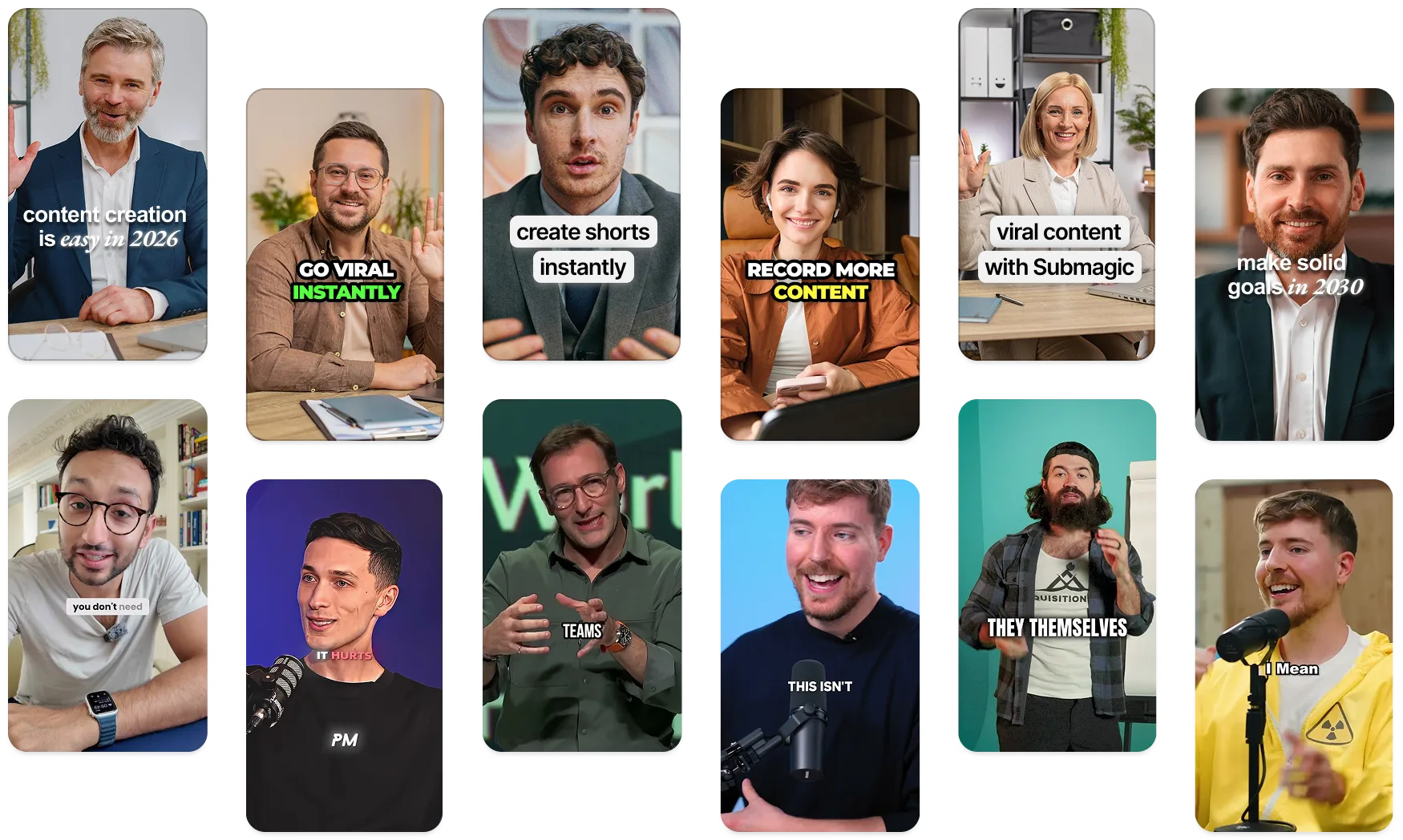
Essas empresas confiam e adoram as legendas geradas pela IA da Submagic.


It is a short spoken-word outline for a video where you coach your audience through one problem. A good one names a real client struggle, gives a specific insight, and ends with a small action they can take right away.
Start from one narrow struggle your client actually has, not a broad topic. Say the struggle out loud, teach a single idea that shifts it, then close with one concrete step. This tool drafts that flow for you when you enter the topic.
Three things carry most coaching videos: a hook that names the struggle, one focused insight or reframe, and a confidence-building micro-action to end on. Skip the long intro and the multi-point lecture; one clear takeaway works better on camera.
For short-form, aim for 30 to 90 seconds, which is roughly 80 to 200 spoken words. A 60-second script runs about 150 words at a natural pace. Longer teaching videos can go further, but one idea per video keeps retention high.
The ones tied to a specific moment of friction: impostor syndrome before a launch, pricing fear, a stalled habit, the first hard client conversation. Specific beats general here, so "fear of raising your rates" outperforms "confidence" as a prompt.
Yes. The topic field is required, and you can add an optional audience (like first-time founders or busy parents) and a goal (like feeling ready to ship by Friday). Both narrow the script's language and the action it points to.
It returns three coaching script options from one topic, each a complete spoken-language draft you can copy. Three gives you a few angles to compare so you can pick the one that fits your delivery.
Trying to cover several ideas in one video, opening with a slow throat-clear instead of the struggle, and ending without telling the viewer what to do next. Vague advice with no concrete step is the one that quietly kills engagement.
Yes. The drafts read as natural spoken language, so they fit Reels, Shorts, and TikTok as-is, and they also work as the backbone of a longer teaching video. Trim or expand the middle insight depending on the runtime you want.
Começar a usar



O Submagic é a melhor ferramenta de IA para criar vídeos curtos envolventes em segundos para equipes e empresas.